Cat and Shanmao's blog
Monday, May 30, 2005
Opus Clavicembalisticum
I first heard about this piece from my friend Christian who is another piano nut (a record store owner in Toronto commented that I was one).
From the Sorabji Archive I learned that
Kaikhosru Shapurji Sorabji was born in Chingford, Essex, England on 14 August 1892; his father was a Zoroastrian Parsi civil engineer and his mother - as far as is known - was a part Sicilian, part Spanish soprano. He spent most of his life in England. From his early 'teens he developed an insatiable appetite for the latest developments in contemporary European and Russian music and went to great lengths to obtain the latest scores of such composers as Mahler, Debussy, Schönberg, Skryabin, Rakhmaninov and others at a time and in a country where almost all such music was largely unknown and unrecognized. Of an independent and uniquely curious nature, it is perhaps unsurprising given the pre-War English environment that his education, both general and musical, was mostly private.
The score is 250 pages. A performance should take 4 hours. The bizarre dedication is
To my two friends (e duobus unum) Hugh M'Diarmid and C. M. Grieve likewise to the everlasting glory of those few men blessed and sanctified in the curses and execrations of those many whose praise is eternal damnation, June 1930.From an Amazon reviewer:
"Opus" is in three massive parts. "Pars Prima" consists of an "Introito" followed by a "Preludio-Corale," a Fugue (I) in four voices, a "Fantasia," and a Double Fugue (II). The sequence together needs fifty minutes or so, with the two fugues needing about a quarter of an hour each. "Pars Altera" consists of an "Interludium," really a set of sixty-nine variations on a theme, a "Cadenza" (I), and a gargantuan Triple Fugue (III). The variations need forty-five minutes and the Triple Fugue thirty-four. "Pars Tertia" consists of an "Interludium" (II) further subdivided into a Toccata, an Adagio, and a Passacaglia with eighty-one variations; now comes a "Cadenza" (II), after which there is a Quadruple Fugue (IV) and "Coda-Stretto." "Pars Tertia" needs an hour and forty-five minutes for its sequence to play out. What possible attraction is there in a solo piano work lasting so long? Can a listener hope to make sense of a Quadruple Fugue of forty minutes performance-duration? The answer is "no" and "yes." One can only just barely grasp the internal logic of one of Bach's longer fugues or one of Reger's. Sorabji creates imitative structures four or five times longer than those of either of these two precursor-composers. With Sorabji, one remembers that what one might call "something fugal" is unfolding before one's ears; and then one, so to speak, "identifies with it" by mystical intuitive union. Preparation is a "sine qua non" of the endeavor, for once interrupt the audition and the thread of sympathy is broken: one must set aside the requisite chunk of time, discharge one's other obligations, and then summon the spirits of endurance and concentration for all the assistance that they can give. The validity of Sorabji's accomplishment lies in the adequately prepared auditor's absolute conviction that "this is not a hoax" but a genuine "higher experience." "Opus Clavicembalisticum" belongs to the genre of vast works in appreciation of which a certain faith is the prior stipulation: Wagner's "Parsifal," Havergal Brian's "Gothic Symphony," Nicholas Maw's "Odyssey," Morton Feldman's "String Quartet (II)," or Alexander Nemtin's completion of Alexander Scriabin's "Preparation for the Final Mystery." Like Scriabin (in his conception of the "Mystery"); like Brian or Maw - Sorabji is a "maximalist" rather than a "minimalist." The aural impression is analogously of a primal nebula spinning off stellar and planetary systems, which evolve through the main sequence and burst into novae, only to die away as clouds of red glowing gas. These then provide the raw material for further grand spasms of cosmic creation and de-creation. My appetite is now whetted to hear "Opus Clavicembalosymphonicum," a similar four-hour contrapuntal exercise for piano and orchestra, or the "Jami" Symphony. for vocal soloists, choral forces, piano, and orchestra. It will probably never happen, but the keyboard works should garner a dedicated and persistent audience. Recommended to brave souls.
Wednesday, May 25, 2005
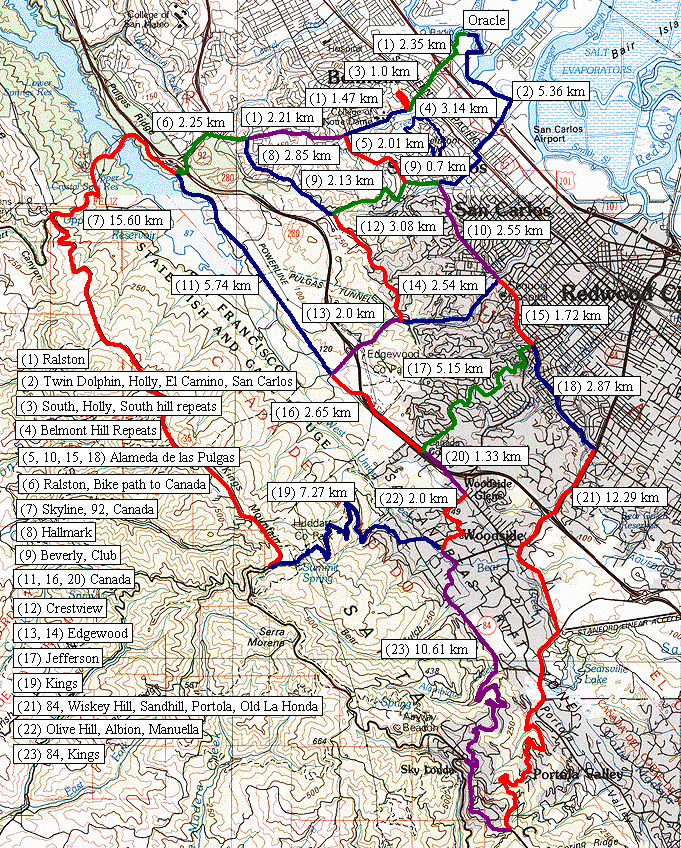
Bicycling routes around Oracle
Links
- Gui and Matthew's Home Page
- Gui and Matthew's Guestbook
- Jean's blog
- Letters from Thailand
- The weather in San Mateo
- Peninsula Library System
- San Francisco Public Library
- San Mateo County Transit
- Caltrain
Archives
current
01/01/2004 - 02/01/2004
02/01/2004 - 03/01/2004
03/01/2004 - 04/01/2004
06/01/2004 - 07/01/2004
07/01/2004 - 08/01/2004
10/01/2004 - 11/01/2004
11/01/2004 - 12/01/2004
12/01/2004 - 01/01/2005
01/01/2005 - 02/01/2005
02/01/2005 - 03/01/2005
04/01/2005 - 05/01/2005
05/01/2005 - 06/01/2005
02/01/2006 - 03/01/2006
03/01/2006 - 04/01/2006
06/01/2006 - 07/01/2006
10/01/2006 - 11/01/2006
12/01/2006 - 01/01/2007
01/01/2007 - 02/01/2007
02/01/2007 - 03/01/2007
03/01/2007 - 04/01/2007
04/01/2007 - 05/01/2007
06/01/2007 - 07/01/2007
07/01/2007 - 08/01/2007

