Cat and Shanmao's blog
Tuesday, July 24, 2007
Yet another great musical resource!
http://pianosociety.com/cms/index.php?section=1
I came upon this website while searching for free and ideally legal recordings of Schubert G major piano sonata D984. I had read something about this sonata and wanted to sample it for a few moments since this is one of those pieces that, while I've listened to it a number of times, haven't really digested. There are many such pieces that I know of and am a little bit familiar with but look forward to absorbing in the future. With the help of websites like Piano Society this task will be easier.
Monday, July 23, 2007
Manufactured Landscapes
The Harry Potter is what you'd expect from a blockbuster based on the popular books. Witches and warlocks, an academy for the occult arts, giants and centaurs, an evil force to be vanquished.
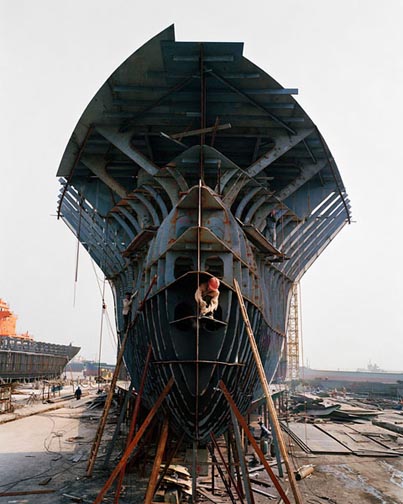
Manufactured Landscapes is a fascinating documentary about landscapes that have been changed by man's industrial processes. The landscapes are documented in photos by Edward Burtynsky who travels the globe looking for open pit mines, factories, docks, shipyards, scrap heaps, demolitions, urban etc. He focuses on China, with an excursion to Bangladesh, since this eastern industrial behemoth is currently undergoing profound change. America and Europe went through profound changes in earlier decades and are shedding their industrial past as they move deeper and deeper into the service age.
The opening sequence pans for minutes and minutes through a long, long factory showing Chinese workers at assembly lines piecing together various items. Except for the size of the factory this reminded me of the factory where I worked during the summer when I was 17 and 18. I assembled side view mirrors for cars there during the 'afternoon' shift (4pm - 2am, 4 days a week). I remember biking home in the pitch blackness of the country roads around Ashburn and the cameraderie with the other factory workers, mostly older women with some highschool and college students thrown in.
Burtynsky visits all sorts of places in China from coal yards, to ship building yards, to factories, to urban Shanghai, to the 3 Gorges dam. Interestingly, he shows the resident of evacuated cities in the 3 Gorges flood area demolishing there former cities. To allow ships to travel in the newly flooded locations, the tall buildings must all be razed.
The shipyards are very interesting to me and fascinating for Burtynsky. Globalization is largely about shipping. Without the massive cargo ships to transport goods around the world globalization would not be possible (there has been talk of reviving dirigibles but since no one has yet commercialized the idea in recent times we can safely say there is no alternative). The China sequence shows the birth of ships and the Bangladesh sequence shows the death of ships. Old vessels are run onto the beaches in Bangladesh and dismantled by hand by poorly paid workers. Oil tankers are dismantled and the leftover crude and sludge is harvested by hand. This is quite a frightening site because you can imagine how many horrible accidents are bound to happen.
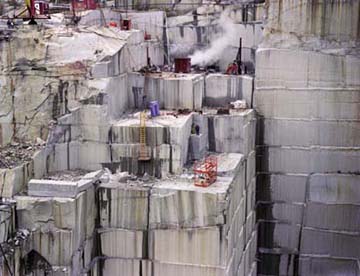 Interestingly, Burtynsky avoids judgement on the images he presents. An environmentalist might lament the 'rationalization' of the landscape and the pollution. An economist might praise the same rationalization. A nationalist would feel pride at the success of his or her country. A protectionist from elsewhere would feel outrage that industry has left his or her country. Burtynsky, in a voice over, tells us that he leaves judgement up to the viewer. He presents images he finds interesting and lets the reader decide what the images mean, if anything.
While disturbing in a way, the images were fascinating in the geometry of some and in the mosaic like composition of some. The reality of massive production and the unpleasantness of the logistics required don't bother me so much. For the parties involved, this is their way forward to increase their wealth. Large populations in countries where industry has since moved on would love to have all that unpleasantness back. They don't mind the grind of working of factories - they would love to be the ones to assemble the widgets because that means a job. But, they can't have this unpleasantness because the global economy has determined that it is better done elsewhere.
Here's Burtynsky's talk/slideshow accepting his 2005 TED Prize: http://www.ted.com/index.php
This gallery in downtown San Francisco has his photos: http://www.kochgallery.com
For Jean's perspective on the movie go here.
Tuesday, July 17, 2007
Classical music educational lectures online
http://music.guardian.co.uk/classical/page/0,,1943867,00.html
Schiff is a well-known international concert pianist best known for playing Bach and classical composers. Over the course of 32 lectures, he goes through each of the 32 sonatas, describes them, highlights points of interest, provides some historical and musical context, and plays excerpts. He can seemingly start and stop at any point in the music and has clearly analyzed the music so much that he can extract isolated elements for emphasis. His dry wit and soothing voice also add to the experience.
Just found another great resource - BBC3's Discovering Music lecture series:
http://www.bbc.tv/radio3/discoveringmusic/audioarchive.shtml
Several narrators discuss pieces by all sorts of composers. Examples of the music are presented along with some insight and analysis. Compared to the Schiff, these lectures are more straightforward without the humor which is not a weakness but simply their style. Professional musicians play excerpts and also play fragments from the music. By fragment I mean not simply a short portion of the music, but a single voice, a single element, and at times a single note.
Both these great resources are highly recommended and the best part is they are free and can be enjoyed anytime. I've downloaded the Schiff onto my ipod and listen from time to time when I want a refresher on a particular piece.
Links
- Gui and Matthew's Home Page
- Gui and Matthew's Guestbook
- Jean's blog
- Letters from Thailand
- The weather in San Mateo
- Peninsula Library System
- San Francisco Public Library
- San Mateo County Transit
- Caltrain
Archives
current
01/01/2004 - 02/01/2004
02/01/2004 - 03/01/2004
03/01/2004 - 04/01/2004
06/01/2004 - 07/01/2004
07/01/2004 - 08/01/2004
10/01/2004 - 11/01/2004
11/01/2004 - 12/01/2004
12/01/2004 - 01/01/2005
01/01/2005 - 02/01/2005
02/01/2005 - 03/01/2005
04/01/2005 - 05/01/2005
05/01/2005 - 06/01/2005
02/01/2006 - 03/01/2006
03/01/2006 - 04/01/2006
06/01/2006 - 07/01/2006
10/01/2006 - 11/01/2006
12/01/2006 - 01/01/2007
01/01/2007 - 02/01/2007
02/01/2007 - 03/01/2007
03/01/2007 - 04/01/2007
04/01/2007 - 05/01/2007
06/01/2007 - 07/01/2007
07/01/2007 - 08/01/2007

